
Blind Review and the Wrong Answer Journal
When I was studying for the LSAT, someone told me that the real learning happens not during the test but during the review. I am not sure I fully agree. Consistent section and test practice is still the number one driver of score improvement, but reviewing your work well can make a meaningful difference.
I have been telling you to review your wrong and flagged answers after every section and test. Here is exactly what that process should look like.
The Review Process
After finishing a section or test, go back through every question you got wrong or flagged. On this platform, just click the blind review button, which will open this:
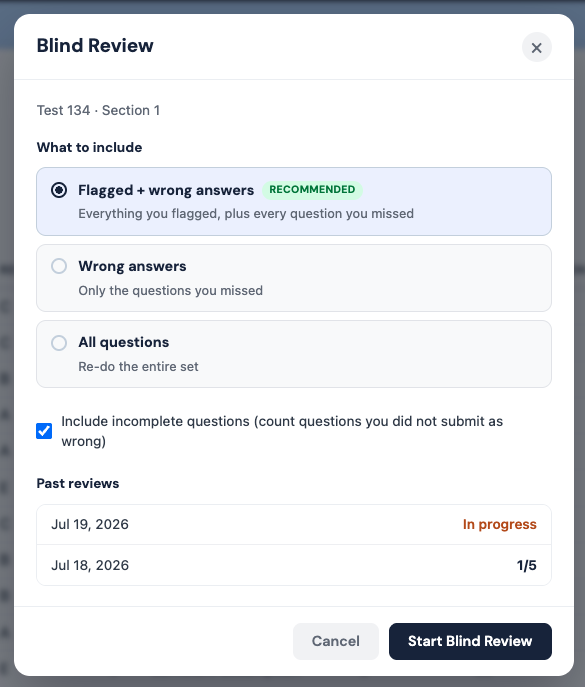
Configure it as you like and it will create a drill set for you. Solve these questions again, untimed.
If you get it right this time, write down in your own words why you think you got it wrong the first time. Maybe you misread the question stem. Maybe you missed a key detail. Maybe you cannot believe you missed something that now seems obvious. Whatever it is, write it down.
If you get it wrong again, read the solution and the answer choice justifications until you understand what went wrong. Then write down what you were missing, why the answer choices you picked are incorrect, and why the correct answer is correct.
During blind review, you will see this button next to each question:

Clicking it opens a space to write your explanation:
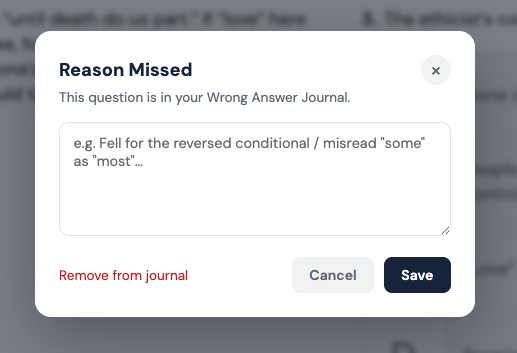
You can revisit everything you have written at any time using the Journal link in the menu.
What to Write
Do not write things like "I got this wrong because I chose A and the answer is B." That is useless and tells you nothing.
Write something specific to what went wrong and generalizable enough to help you on future questions.
For example: if you picked a very strong answer choice on a Necessary Assumption question, you might write: "Picked a strong statement answer on a necessary assumption question. Necessary assumptions require the minimum assumption, not something that guarantees the conclusion. Strong language is usually a sign I am looking at a trap answer."
Or if you picked a beyond-the-scope answer on a must be true question: "Picked an answer choice that talked about cars but the stimulus only talked about trucks. Must be true answers have to be provable from the facts given. If the stimulus never mentioned it, it cannot be the answer."
These kinds of entries are actionable. When you read them back before a future section, they will remind you of patterns in your mistakes and help you avoid repeating them.
Sometimes the mistake really is just careless. For example, you read "agree" as "disagree" in a point of issue question. In that case: "Did not read the question stem carefully. Always confirm what I am actually being asked before reading the stimulus." If you are like me and self-criticism helps you stay sharp, you can be as colourful with your language as you want. The journal is yours.
When to Read the Journal
Briefly look through your journal entries before each practice section. A quick scan of past mistakes will keep them fresh in your mind and help you catch the same errors before they happen again.
On this platform, click the Journal tab to see all your entries.
What Exactly Is "Blind" About This?
You will come across various definitions of blind review. Some people will argue that what I have described here is just "regular review" rather than blind review. The traditional definition of blind review is one of these:
-
Before submitting your answers, you review them untimed and change anything you want. This gives you both a real score and a blind review score.
-
After submitting, you redo the entire test or section untimed from scratch. This again gives you two scores to compare.
In both cases, the "blind" part is that you do not yet know which answers were marked correct and which were marked incorrect.
In my opinion, both of these approaches are a big waste of time. They might be worth it if you have unlimited hours, but most people do not.
The LSATSelfPrep version of blind review is this: go through only your wrong and flagged answers one by one, and write explanations for why you missed each one. The "blind" part is that you are resolving each question without being told the correct answer first.
Some people would say I should not call this blind review. To those people: I built this platform, I can call it whatever I want. "Blind review" sounds considerably cooler than "review." Deal with it.
If you genuinely want to do blind review the traditional way, select the "All Questions" option on the platform. Only do this if you have the time and genuinely want to.
GLHF!