
Intro to the LR Section
LR sections make up two-thirds of your LSAT score. Unlike Reading Comprehension, you've probably never seen questions like these before — and that's actually a good thing. You get to learn from scratch without developing bad habits (breaking bad habits is the hardest part of RC prep, since most people have done reading comprehension before and come in with ingrained tendencies).
Disection of a LR Question
Every LR question has three parts:
- A stimulus — a brief paragraph that gives you some information
- A question stem — tells you your task for that question
- 5 answer choices — one of which is the most correct
Here is an example:
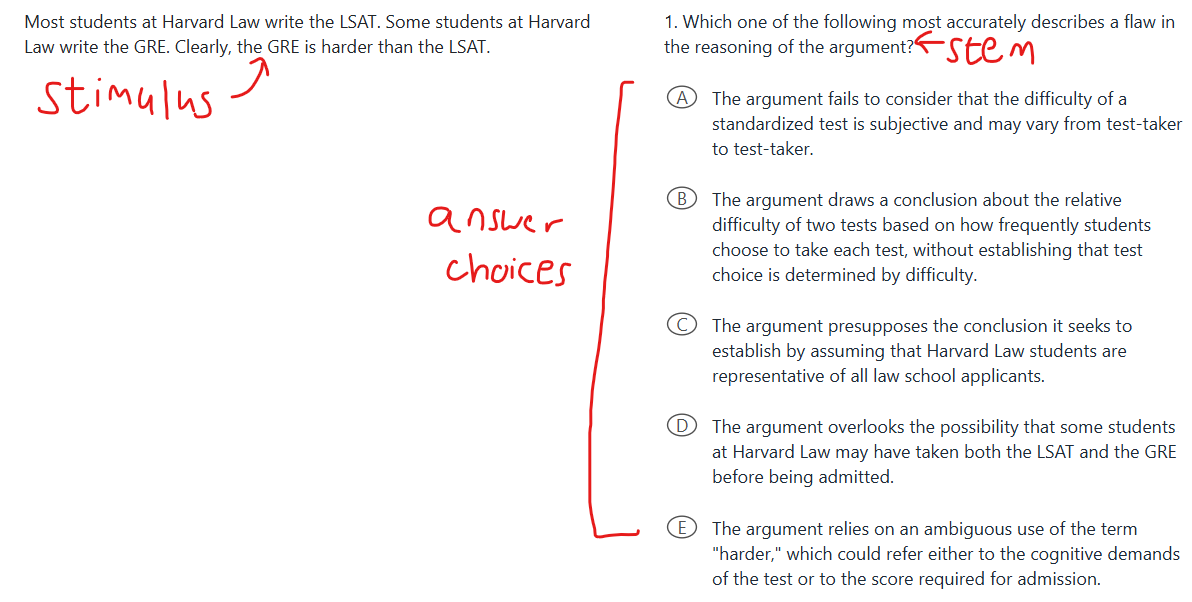
The stimulus here has some information about Harvard Law students and claims that the GRE is harder than the LSAT. The question stem gives us our task, we need to find the flaw the stimulus. There are five answer choices as well, one of them is the most correct. I do not expect you to solve this question right now by the way, this is not the point. Just get familiar with the different components of a LR question and how it will be presented to you.
Types of Stimuli
I have already mentioned that we are going to learn by mastering each question type. Each of these question types can be further grouped by the type of stimulus.
There are 4 main types of stimuli you'll encounter:
- An argument: A stimulus with premises and conclusions
- A fact pattern: A stimulus with just a bunch of facts
- Two people arguing: A stimulus with two speakers talking about something
- A paradox: A stimulus with contradictions
Check out this graph which shows the distribution of these stimulus types across the 59 official PrepTests:
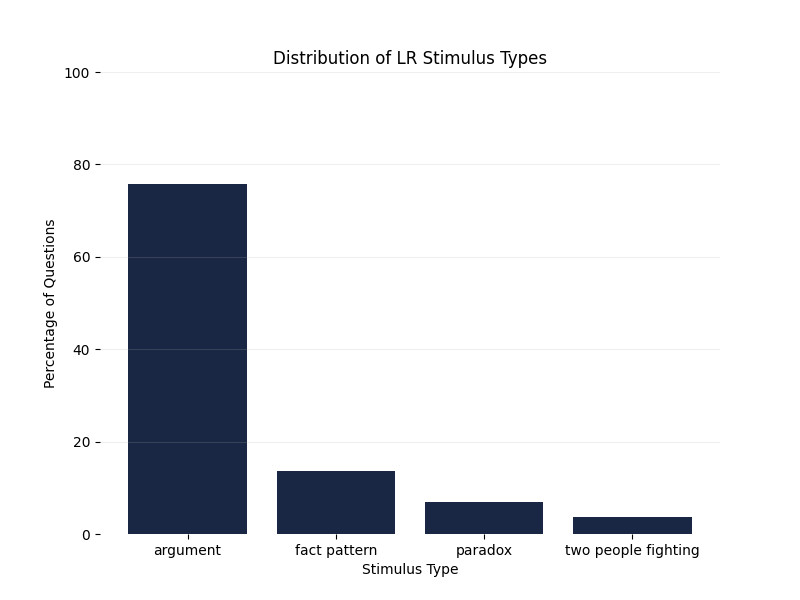
The first type — the argument — is the most complex and by far the most important. Roughly 76% of stimuli you'll encounter will be an argument.
Difficulty and Question Order
All LR questions have a difficulty level from 1 to 4, with 4 being the hardest. A standard LR section has 24–26 questions, and the difficulty tends to increase as you move through the section.
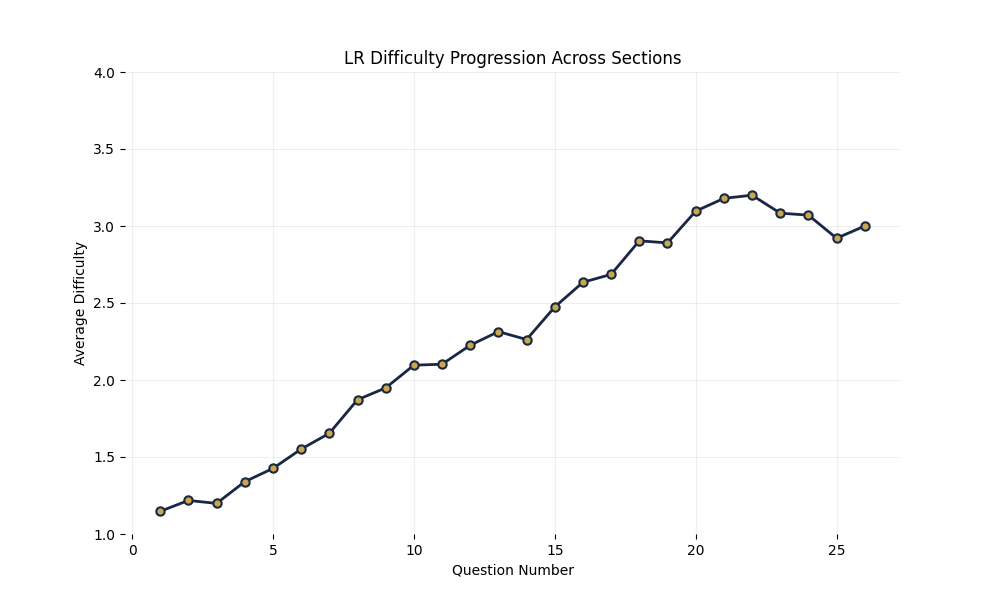
This is an analysis of all LR sections across the available past tests — about 156 sections. As you can clearly see, difficulty rises as the question number increases.
Why does this matter? It's critical to get the first 10–15 questions out of the way as quickly as possible. These are typically Level 1 and Level 2 questions that test your fundamental understanding of each question type. The only way to move through them quickly is to have your fundamentals locked in — which is exactly why drilling by question type is so important.
The goal you're eventually working toward: finishing the first 15 questions in about 15–17 minutes.
And as we covered in the previous chapter, an easy question and a hard question affect your score exactly the same way. So it's perfectly fine to miss 1 or 2 hard questions at the end — the goal is obviously to finish everything, but not at the expense of multiple easy ones.
Okay, enough background. It's time to actually start studying — for real this time.